
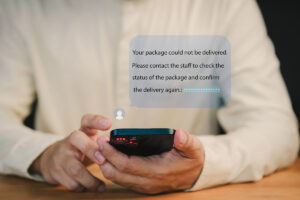
 Fake package delivery scams.
Among the most commonly reported text delivery scams1, package delivery scams appear to be sent from the U.S. Postal Service, FedEx, UPS, or other delivery services and often include a link to a site similar to the company’s official website or include a number to call.
This tactic leverages its credibility to entice users into paying a “redelivery fee” and, in some cases, to provide their Social Security numbers.
What To Do About It
- Avoid clicking links or scanning QR codes on packages; they may lead to harmful sites
- Do not call any numbers provided in a suspected fraudulent text
- Verify independently; legitimate delivery companies won’t ask for payment or personal info via text
- Don’t share sensitive information
- Report scams at ReportFraud.ftc.gov
Protect yourself.
You can protect your identity and your accounts by keeping your personal information, well, personal. Unless absolutely necessary for a legitimate business purpose, you should avoid giving out your:
- Address and zip code
- Phone number
- Date of birth
- Social security number
- Card or account number
- Card expiration date
But when it comes to your PIN, that’s for you to know and for no one to find out.
Never share your PIN numbers for cards or accounts.
You should also never respond to unsolicited emails that:
- Ask you to verify your card or account number
- Ask for any other kind of account information
Good Advice For Every Situation
Did you know that you can copy suspicious messages and forward them to 7726 (SPAM)? Sending examples helps your wireless provider spot and block similar messages in the future.
You can also:
- Verify the source using a known method
-
Avoid clicking on links in texts
-
Avoid scanning QR codes presented in public places
-
Never share sensitive personal information
- Block the number
- Delete the message
- Report scams at ReportFraud.ftc.gov
For more information on our fraud monitoring, detection, and protection services, visit our Fraud Monitoring & Protection page or learn more at: How to Recognize and Report Spam Text Messages
Reference:
DAD, T. K. (Acting, Nguyen, S. T., Division of Consumer Response and Operations Staff, & Fletcher, E. (2025, May 22). Top text scams of 2024. Federal Trade Commission. https://www.ftc.gov/news-events/data-visualizations/data-spotlight/2025/04/top-text-scams-2024